

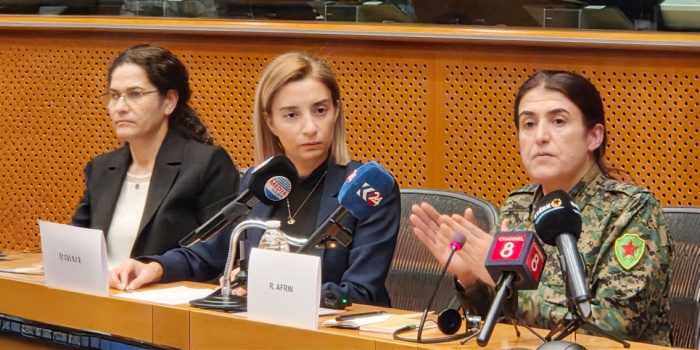
In the framework of intensified diplomatic efforts aimed at reaching a just and lasting resolution to the Syrian crisis, Brussels became the venue on Feb. 25, 2026, for a pivotal meeting at the European Parliament widely viewed as a significant step toward internationalizing the Kurdish cause and shaping Syria’s political future.
The meeting, which witnessed the active participation of prominent leaders from Western Kurdistan (Northern Syria), is being regarded as a critical turning point in elevating the Kurdish file onto the broader international agenda.
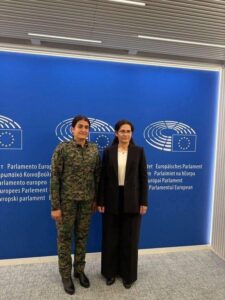
Among those present were Ilham Ahmed, Co-Chair of the Department of External Relations of the Autonomous Administration, and Rohilat Afrin, General Commander of the Women’s Protection Units (YPJ). Discussions were conducted in depth and with precision, focusing on the sensitive current situation in Western Kurdistan and Syria as a whole.
The central theme of the session revolved around reaffirming the necessity of safeguarding the constitutional and national rights of the Kurdish people and all components of society in any forthcoming political settlement. Participants stressed that the only viable path toward a definitive resolution lies in adopting a democratic and peaceful system for a new Syria.
Within this context, the role of the European Union was highly valued as an influential actor capable of supporting such a political process. Particular emphasis was placed on the proposal to establish a long-term monitoring mechanism aimed at ensuring the implementation of decisions and preserving stability.
The discussions also addressed the geopolitical ramifications unfolding across the region, particularly developments in Iraq and Iran and their potential reflections on the situation in Western Kurdistan. Participants agreed on the necessity of full preparedness to address any new scenarios that may emerge on the regional political horizon.
The meeting comes at a time when the Syrian file is entering a renewed sensitive phase and international efforts to redraw the country’s political roadmap have intensified. After years of war and sacrifice, the Autonomous Administration in Western Kurdistan has succeeded in presenting itself as both a governance model and an influential military and political force.
Efforts are now increasingly directed toward transforming this de facto authority into a recognized component of Syria’s future constitutional framework. The convening of such meetings within the European Parliament sends a clear signal that the international community can no longer overlook the Kurdish role in regional equations, and that resolving the Kurdish question has become a key pillar for achieving stability in the Middle East.